DPS – Routeburn Field Trip July 2016

Participants: Craig McKenzie, Glenn Symon, David Steer, Jenny Longstaff

Article written by Jenny

Hooray! End of the working week and let’s get outta here! Arrived at Sylvan campsite (60+km beyond Glenorchy) by about 10.30pm and erected our tents under the trees to keep out of the hoar frost zone. Seemed to be several other campers tucked away too, plus deer. Hot cuppa brewed and so to bed, snugly tucked up in several layers and sleeping with camera to keep battery warm (I only had the one battery, unlike Craig who had 10!).

rosy-fingered dawn / beckons early riser / cupping a tin mug

Caterer Craig’s cordon bleu fare provided nourishment then off to the start of the Routeburn Track. The guys were lugging their tramping packs, camera bags and tripods, signalling  a serious photographic expedition, while my camera gear is a small point and shoot waterproof camera (not that I have ever used it underwater, but on a South Island tramping trip you never know!!). I was on the trip mainly for the tramping and was delighted to discover that it triggered some poetic notebook scribblings, as you shall see interspersed in this account.

green therapy / nature’s healing touch / in the balm of your land

The track itself and bridge crossings are very well constructed, the Routeburn Track being designated a Great Walk. Our destination for Saturday night was the Routeburn Falls hut, (capacity 48), so with plenty of time to get there and only 8 or so km to walk, we could dawdle beside the picturesque river, photographing the beech forest, ferns, waterfalls, mossy rocks and other forest details, with some kakariki, south island robins, tom tits and riflemen for company.

inquisitive visitors / tiny bush birds / strut their fluff

We took a lunch break at an old landslip site which afforded great views across to the Humboldt Mountains, then eventually we arrived at the Falls Hut, dumped our things then out again to explore the Falls area, rich pickings for compositions of rocks and water, foliage, mountain scenery and atmospherics. The weather was holding well, so I continued along the track until I could get a view of Lake Harris.

focused photographer / captures panorama / exposure on the summit

The evening was spent consuming Chef Craig’s candle-lit dinner and huddling over a reluctant wood burner. (The next morning he discovered the water tank and the coal shed.) We had chatted to some other trampers on the track, but the only other people staying at the hut were two young Invercargill women. Tough kiwis go winter tramping!

crumbling erosion / swirling tannin waters / dunking gingernuts

And then it rained all night. A deluge. No point getting up early. Later in the morning in typically fickle style it cleared and we ventured out at 11-ish, spending time checking out the waterfalls, gushing most spectacularly, before we descended to the lower valley for other riverside photo stops, with a lunch break at the Routeburn Flats hut.

raging river / chuting the rapids / canyon clefts

The rain had woken up all the tiny lichens and mosses and had turned the river and side streams into torrents, but we were relatively dry on our hike out.

washed clean / forest greens gleam / radiant after rain

It was a pretty good outing for photographic variety, from wide angle vista to macro minutiae, and best part on a tramping excursion with fellow photographers is that they don’t pick on you to keep up! Back at the vehicle it was good to shed our packs and get out of our boots, then we did a side trip to photograph ‘the Paradise tree’. A great weekend away, proving that you can cram a lot into a short space of time, creating memorable moments.

tongues hanging out / waiting by back door / muddy hiking boots
Enter Now: Spring Print Exhibition

A gentle reminder about the upcoming Spring Print Exhibition.
 
Closing date for entries: Monday 8th August 2016 (at our meeting)
Members can submit up to six entries in each of the Open and Natural History Sections.  More details.
 
We will be exhibiting the selected images at the Dunedin Community gallery, so this is a great opportunity to get your work on display to the public. John Hart will be selecting images for the Open section and Paul Sorrel selecting for the Natural History section.
 
John Casey has organised a good deal with the Framing Factory in South Dunedin if you need to purchase new mats and foam core backing. Contact John or Laurie by 25th July to order your mats.

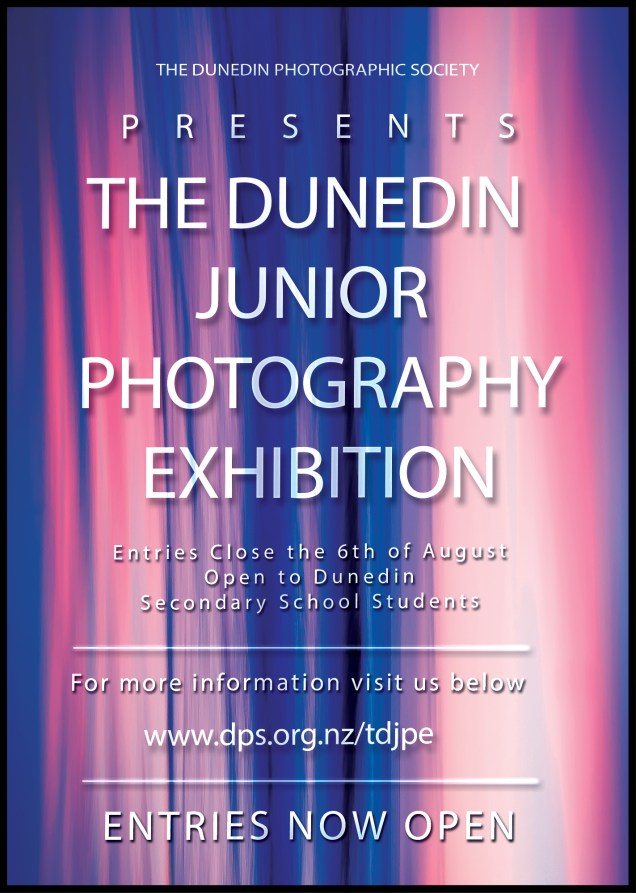
The Dunedin Junior Photography Exhibition

Entries are now open for the The Dunedin Junior Photography Exhibition.
Open to Secondary School students in the Dunedin area, the Exhibition will be displayed alongside the Spring Print Exhibition at the Dunedin Community Gallery between the 29th and 31st of August.

Please share the links below, or the blog post itself, to anyone you know who may be interested in entering.

Entry and information: https://dps.org.nz/tdjpe/

Facebook page : https://www.facebook.com/tdjpe/

tdjpe2016

Guest Speaker: Rod Morris

Meeting: Monday June 27th

Rod Morris, who is a well known and award-winning natural history filmmaker, author and photographer, was the guest speaker on Monday night.  His talk titled ‘ Pinch of Salt – Seashore macro photography’ was based around his most recent work, producing a field guide to the New Zealand seashore, in conjunction with Sally Carson from the Portobello Marine Science laboratory.

Accompanying his talk, were many photographs of the wonderful and weird sea life that inhabit our shores.   There is, in fact, a huge variety of life in the sea that exists and is not that well known.  In fact, about 96% of animals live in an aquatic environment; the rest are terrestrial.  Rod urged us to go out and explore the inter-tidal environment.

Photographing these animals presents several challenges.  First and foremost are two factors that are enemies of the camera – saltwater and sand.  Rod recommended placing a finger near the end of one’s camera lens to provide a warning that the camera is getting close to the water surface.  Rod also uses a point-and-shoot waterproof camera which can produce some pleasing results (particularly cameras that have a tilted screen).  In more sheltered rock pools, it is possible to shoot through the water surface, particularly when using twin flash units.

Another challenge is that many of the animals tend to quickly burrow themselves in the sand if they sense danger. In this case, Rod often took these specimens back to the laboratory  and placed a sheet of glass between the animal and the background sand so that it could not burrow.  After photographing, he would then return the animal to the sea.  He has also used water filters in the laboratory to move sediment and water around the tank, in order to stimulate some activity in the animals (such as barnacles which may close up as a defence mechanism).   There are also various tidal rhythms that can influence the behaviour of the animal so it is important to have a bit of background knowledge of these animals.

Rod’s talk has certainly inspired us to head out to the seashore and explore.  We  look forward to the publication of his field guide.

Member Profile: Matheson Beaumont

This slideshow requires JavaScript.

Year joined DPS 1948
Signification positions held in DPS
  • President on three occasions, the last for our 100th Anniversary year.
  • Chairman of the Organising Committee of the 50th PSNZ Convention in Queenstown
  • Current Patron
Honours ONZM, FRPS, FPSA, Hon FPSNZ, Hon FNPSNZ
Current camera Canon D5
Favourite camera you have ever used/had Although I love my D5,  I had a love affair with Olympus for a number of years owning OM1, OM2, OM3 and OM4’s
Which do you prefer: Film or Digital? Digital
And why? I enjoy the ability one has to manipulate the image, to make it into the picture you envisaged at the time of taking.
Which do you prefer: Print or Projected? Print
And why? I am a print maker, and prefer this medium to the projected image. I had a long involvement with Slides from the early 1950’s and even pioneered Multi Screen Audio Visuals in NZ , in the early 1970’s. My AV’s being shown around NZ, in Australia as well as in London.
How did you get into photography? I was given my first camera about 1942 whilst at High School. Living next to my parents in St Clair were the Erwin’s; energetic members of DPS. Occasionally Mrs Erwin would bring members of DPS in to our garden to photograph the Gold Fish in our Lily Pond, which fascinated me. And as I grew up I was impressed by the pictures of scantily clad girls on the covers of the Photographic Magazines in the Book Shop at the St Clair Beach, so these two influences were significant.
What is your most memorable moment from your time at DPS so far? Presenting my Multi Screen,  6 Projector AV. ‘Something Special’ To the 21st.  PSNZ Convention in Queenstown. – To a standing ovation.
What keeps you inspired with your photography? The Challenge of image making and the involvement with the special people who share the same interest.
Do you have a particular theme that would summarise your photographs? I love the Landscape and the challenge that it presents. I have pursued many branches of photography, from Marine to Portraiture and Genre, but it continues to be the Landscape which presents for me the greatest challenge.
Where is the best place that you have been to take photos? I have photographed in many places from Mexico to Tibet, in The UK the USA and Europe, but the place that really brings me on is the Mackenzie Country and the ‘Lindis’ Pass. When I am there and the light is “right” I think that I ‘vibrate’.
What piece of equipment could you not do without in your camera bag? My Canon 28mm to 135mm zoom.
Do you have any advice for your fellow photographers? Learn to Look.  And having looked – See!
Any other comments? Some thoughts on photographing the Landscape.
The very nature of the photographic process is perhaps the reason for the landscape being so seldom done well. Photographs are made in a 125th of a second, usually less, and are often made by casual photographers who are out “Taking Pictures”. If the painter could rip off a canvas in so short a time, the world would be without many of its great works. The photographer who understands the landscape takes time to contemplate and actually feel what is going on in front of the lens. The skill is in ‘making’, rather than the predatory ‘taking‘  which leads to success.The great landscape relies on fine union of trained eye and imaginative mind. To make it you must be not only intellectually involved, but sensitive to what is going on in the subject, if you are you, you will have a better chance of communicating your feelings to your viewers. The photograph should open up our minds to the mystery of the scene and allow our imagination to to escape”.